


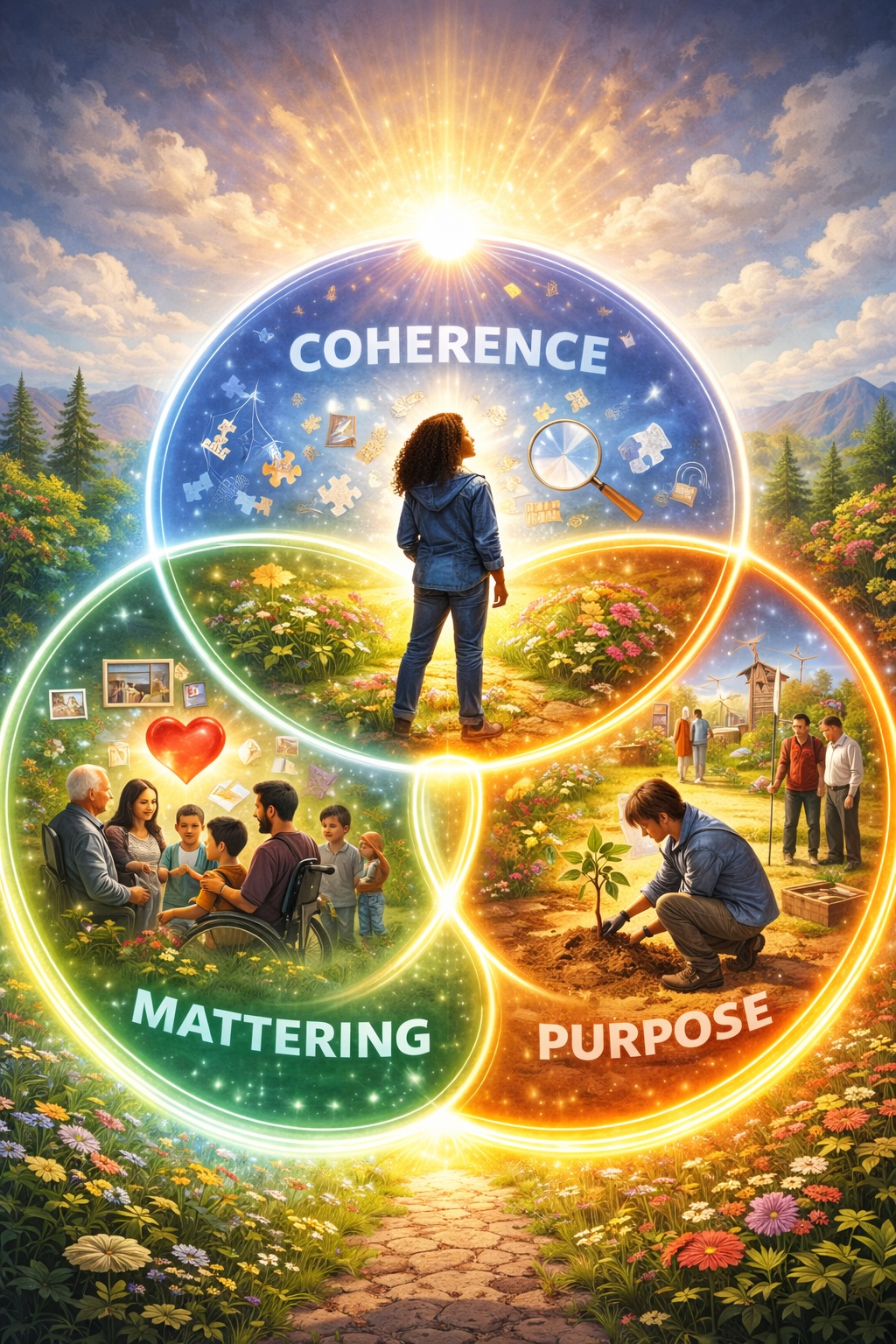
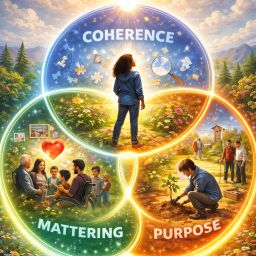
For decades, “meaning in life” (MIL) was treated as a vague, poetic concept—something for philosophers to ponder over coffee, but a bit too “mushy” for rigorous psychological science. That changed with the emergence of the Tripartite Model proposed by George and Park (2016). The model proposes three aspects of meaning (being-in-the world) which vary in valence across time but are interrelated. These three are Coherence, Purpose, and Mattering. Whether you are designing a longitudinal study or sitting across from a client in distress, understanding these three dimensions can be a game changer.
The Three Pillars of Meaning
1. Coherence (The Cognitive Dimension)
Coherence is the “sense-making” component. It is the feeling that one’s life is predictable, orderly, and makes sense. When a person has high coherence, they can weave their past, present, and future into a logical narrative.
• For Researchers: Coherence is often linked to cognitive processing and trauma recovery. It’s the “why” behind the “what.”
• For Practitioners: If a client feels their life is chaotic or “broken,” you are likely working on the Coherence pillar. Narrative therapy is a powerful tool here to help rebuild a sense of predictability. (See Lorraine DeKruyf’s Introduction to Narrative Therapy, for a thorough and engaging introduction.)
2. Purpose (The Motivational Dimension)
Purpose is the “goal-oriented” component. It involves having highly valued, overarching aims and aspirations for the future. Purpose is the “engine” that drives action.
• For Researchers: Purpose, the forward-looking component of MIL, is strongly associated with health promoting behaviors such as smoking cessation and medication adherence among diabetics (Weston, Hill, & Mroczek, 2024). It has also been linked to general mortality/longevity (Martela, Laitinen, & Hakulinen, 2024; Zábó, 2025).
• For Practitioners: When clients feel stagnant or “stuck,” the intervention often requires identifying core values to reignite a sense of direction. Evidence supports that developing a sense of purpose and self-directedness significantly reduces subjective stress (Sutin, Luchetti, & Terracciano, 2024), long-term effects of childhood trauma on adult anxiety and depression (Rajendra, Van Doren, & Zainal, 2026), and cognitive impairment (Mikulak / UC Davis Study, 2026)
3. Mattering (The Existential Dimension)
Mattering (called Significance by some researchers) is the “worth” component. It is the belief that one’s existence is valuable and makes a difference in the world. While Purpose is about doing, Mattering is about being. Some work by Martela and colleagues suggest that this component is bifurcated into cosmic versus interpersonal mattering (Guthrie, Maffly-Kipp, Gause, Kim, Martela, & Hicks, 2024). The evidence is suggesting that both experiences of matter are related in predictable ways to MIL outcomes.
• For Researchers: Recent studies suggest Mattering may be the most critical pillar for protecting against suicidal ideation (Manuel, Pachkowski, & Klonsky, 2025).
• For Practitioners: Many people have goals (Purpose) and a logical life (Coherence) but still feel like they are missing something. This can indicate a deficit in Mattering. “Mattering is malleable,” said Dr. Gordon Flett in a 2023 New York Times interview. Focusing on individual strengths, adjusting work to afford more opportunities at success on engaging tasks, and expressing grievances and practicing self-compassion are all methods to improve one’s sense of Mattering.
Moving Beyond the “What” to the “How”
While these pillars are distinct, they are deeply interconnected. For example, a person who finds a new Purpose (like volunteering) often begins to feel a greater sense of Mattering, which eventually helps them create a more Coherent life story. The Tripartite Model reminds us that meaning isn’t “one size fits all.” It is a delicate balance of understanding our past, aiming for our future, and feeling valued in the present. For psychology professionals, this framework offers a robust language to discuss the “soul” of mental health with scientific rigor.










This really spoke to me. I shared it with my sweetheart and she printed it out, graphic and all, and it’s now around the house so that everybody who passes by can see it.